|
|


|
|
Jump to: Featured Articles | Events Calendar | Translate Newsletter Online
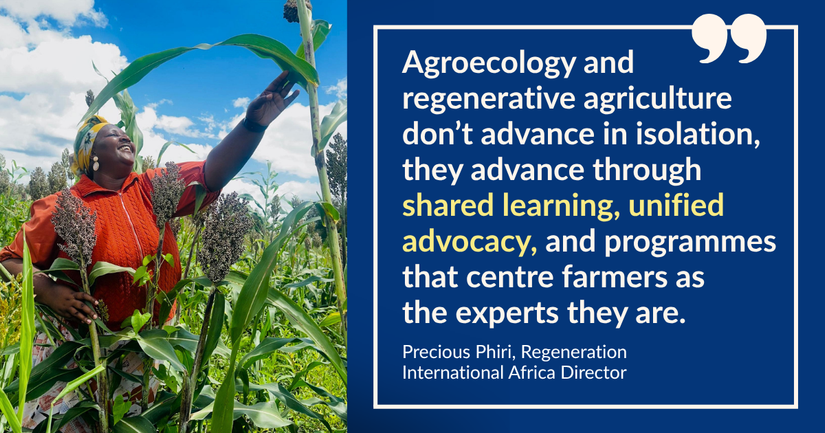
Agroecology in Practice: Chimanimani, Zimbabwe
by Precious Phiri, Regeneration International Africa Director
Last month, I joined PELUM Zimbabwe (a national agroecology network) and partner organisations TSURO Trust and PORETO for a field visit in Chimanimani District in the eastern high and lowlands of Zimbabwe. This visit became a reminder of why networked, community-rooted programmes matter in the fight for food sovereignty in Zimbabwe, and beyond. Agroecology and regenerative agriculture don’t advance in isolation, they advance through shared learning, unified advocacy, and programmes that centre farmers as the experts they are.
The visit was part of the ongoing joint learning between grassroots agroecological organisations, with government stakeholders. The process is critical in shaping the narrative, building capacity and strategies of how to scale up to a point of nourishing the nation and influencing policy. On the ground, results speak for themselves because farmers are at centre stage and this short story is one of many happening around the world.
Learn More
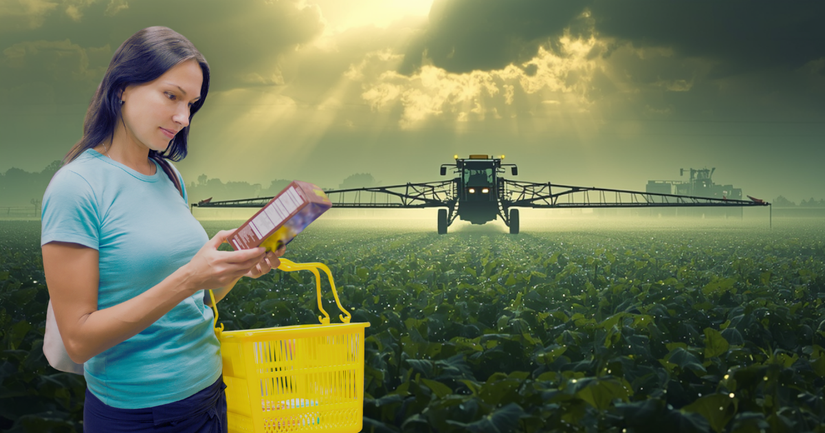
Mexico Delays GMO Labeling Rules Amid Corporate Pressure
Civil organizations are sounding the alarm over Mexico’s failure to publish regulations for its General Law on Adequate and Sustainable Food — regulations that were due in October 2024 and remain unpublished. At stake is mandatory front-of-package labeling for foods containing GMOs and products made with toxic herbicides like glyphosate. Advocates say the Secretariats of Economy and Agriculture are bowing to pressure from transnational food corporations to water down or eliminate labeling requirements — even as the U.S. already mandates GMO labeling. Researchers and food sovereignty advocates are calling on the Mexican government to fulfill its legal obligations and prioritize citizens’ right to know what’s in their food.
Read “Mexico’s Agriculture & Economy Secretariats Pushing to Stop Labelling GMO & Toxic Pesticide Use in Food” by Nancy Flores
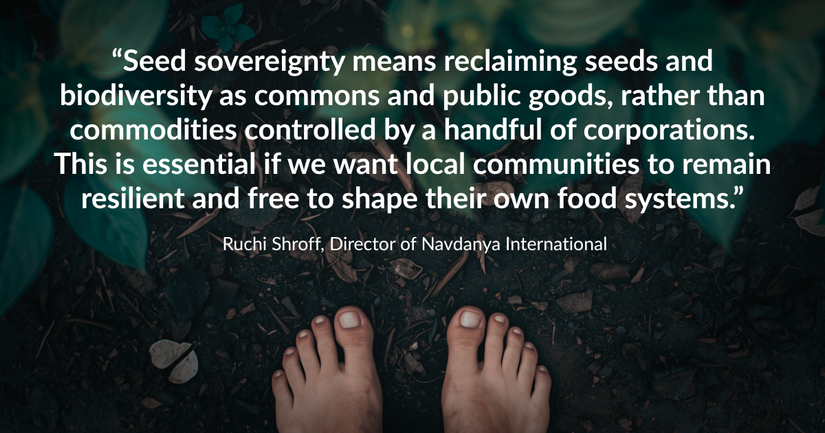
Seed Sovereignty, Biodiversity, and the Future of Food Systems: An Interview with Navdanya International
by Lifestyle Mind
"There’s a quiet revolution happening beneath our feet — in the soil, in the seeds, and in the hands of those who still choose to grow food in harmony with nature.
At a time when industrial agriculture dominates the global narrative, promising efficiency while often leaving behind depleted soils, fragile ecosystems, and disconnected communities, an alternative vision is taking root — one grounded in biodiversity, regeneration, and seed sovereignty.
At the forefront of this movement is Ruchi Shroff, Director of Navdanya International, an organization committed to reimagining the future of food through ecological stewardship, social justice, and the protection of biodiversity.
In this interview, Ruchi Shroff shares her perspective on the urgent need to reclaim seeds, restore ecosystems, and transform the way we produce and consume food. She reflects on the challenges facing today’s global food systems and the deeper cultural shift required to build a more resilient and harmonious relationship with the Earth."
Learn More
Voices of Regeneration
This newsletter reaches more than 740 partner organizations across 80+ countries, each one advancing regenerative food, farming, and land stewardship in their own region, in their own way. This section is dedicated to the people and organizations behind that work. Each issue we'll feature a farmer, researcher, advocate, or partner doing something worth knowing about.
Roland Bunch
Few people have spent more time in the fields (literally) working out how smallholder farmers can restore their soils and feed their families without expensive inputs or outside dependency. Roland Bunch has been doing this work across Latin America and Africa for nearly five decades, and his latest article, What Is the Most Effective Way of Overcoming the "Hurricane of Hunger"? is essential reading. In it, he makes a compelling case that the worsening famine crisis across sub-Saharan Africa is driven less by climate change than by soil degradation, and that the solution is already in farmers' hands. Roland was one of the founding members of Regeneration International at the 2015 Costa Rica gathering and his life's work is the living proof of what RI was built to advance. Watch 10 Years of Regeneration International: Cultivating Soil, Solidarity, and System Change. We also encourage you to check out the second edition of his book, Restoring the Soil: How to Use Green Manure/Cover Crops to Fertilize the Soil and Overcome Droughts. Significantly expanded from the first edition, it is the most comprehensive practical guide Roland has produced.
Are you an RI partner? We want to hear from you.
Every month, we feature partner profiles, stories, and initiatives right here and across RI's social media channels. Whether you have an update about your work, a video highlighting a regenerative solution, or a story from your community, we'd love to share it. Send your content to [email protected] — and if your organization is hosting classes, workshops, trainings, or events, we can help amplify those too.
Not yet part of the network? RI's partner community spans more than 700 organizations in over 80 countries, united by a shared commitment to regenerative food, farming, and land stewardship. Join us here.
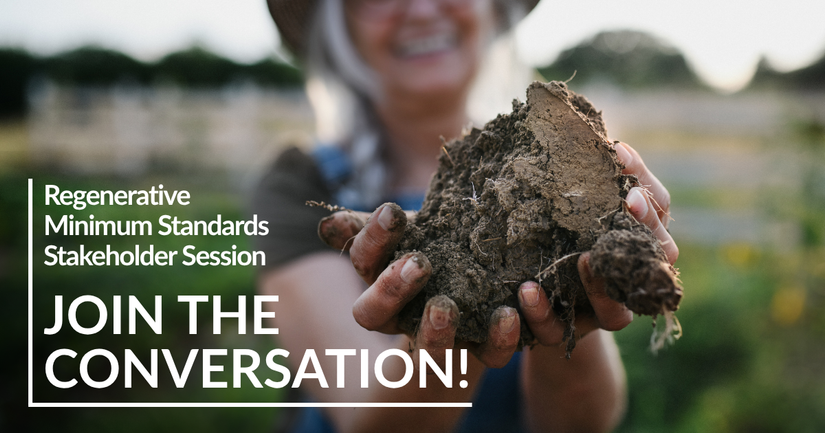
Shaping Regenerative Standards: Join the Conversation
What does "regenerative" actually mean on a product label, and who decides? IFOAM North America and Natural Grocers are hosting a stakeholder conversation on regenerative minimum standards, with the first session focused on synthetic inputs - looking at the the "pragmatic vs. purist" debate head-on to determine whether a minimum threshold for synthetic fertilizer and pesticide use can coexist with genuine regenerative principles. Panelists include Jon Lundgren, Linley Dixon, and Carrie Balkcom, three voices with deep, hands-on experience navigating these questions. The goal is to build industry consensus so shoppers can trust regenerative claims at the shelf, and brands that don't meet the bar stop using the term.
The session takes place April 30 at 10:00 am MT
Register Here
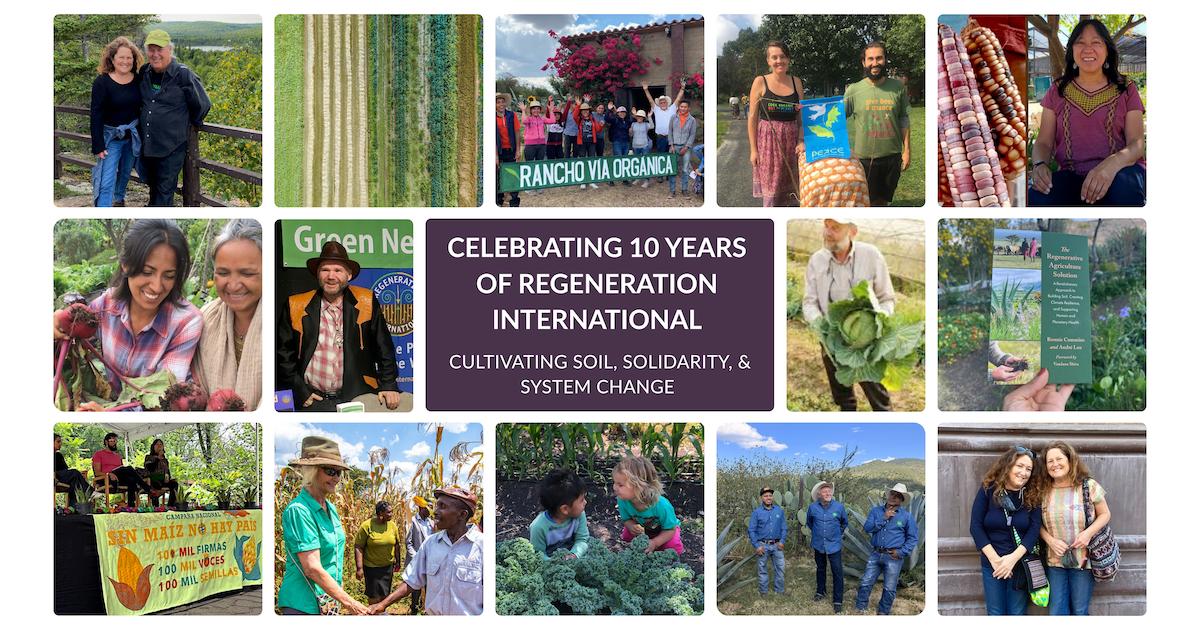
Join the Regeneration Movement!
Transform the way we grow food, heal our planet, and create a sustainable future. Your donation empowers and educates farmers, scientists, and changemakers to implement regenerative practices that:
-Rebuild soil health and boost biodiversity
-Cool our planet by returning carbon to the soil
-Ensure nutritious food for communities worldwide
-Revitalize local economies and create sustainable livelihoods
Every dollar counts. Your support drives positive change across the globe.
Donate today and be part of a powerful worldwide movement restoring our planet's health. Your gift makes a difference. Donate now!
Make a tax-deductible donation to Regeneration International
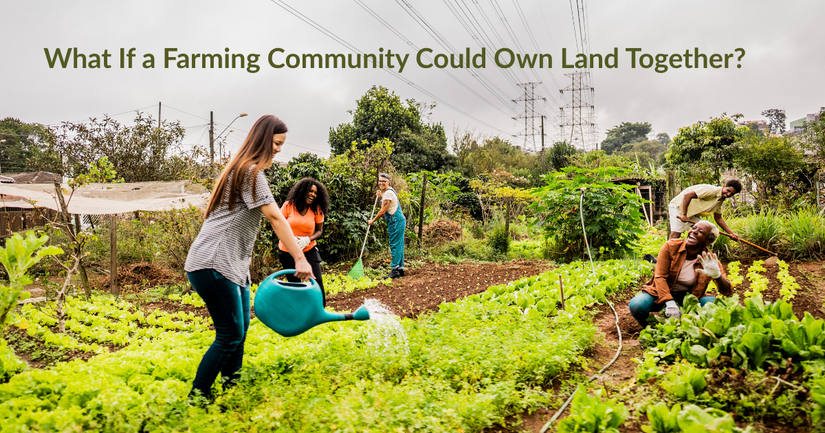
What If a Farming Community Could Own Land Together — With No One in Charge?
That’s the idea behind the Farmland Commons model, and it’s already working in 19 states.
Most community land ownership models still put one nonprofit at the top. The Farmers Land Trust found a workaround: a little-known IRS designation that lets multiple organizations co-own farmland as equal partners. A Black-led food justice group, an Indigenous land stewardship organization, and a regional land trust can hold the same land together — equal power, no single entity calling the shots.
Individual farming families then lease from that shared foundation, building real businesses and generational wealth on land they could never have afforded to buy outright.
The kicker? The legal templates are free. Any coalition can replicate the model without ever calling The Farmers Land Trust. A group in Tennessee is already doing it — using the structure as an explicit act of reparations, entirely on their own terms.
As co-director Kristina Villa learned after eight years managing one of Tennessee’s largest farms: the root cause of food insecurity isn’t knowledge or work ethic. It’s land access. The Farmland Commons model is a structural answer to that structural problem.
Read “A Legal Innovation That Lets Communities Own Their Farmland” by Kevin Jones
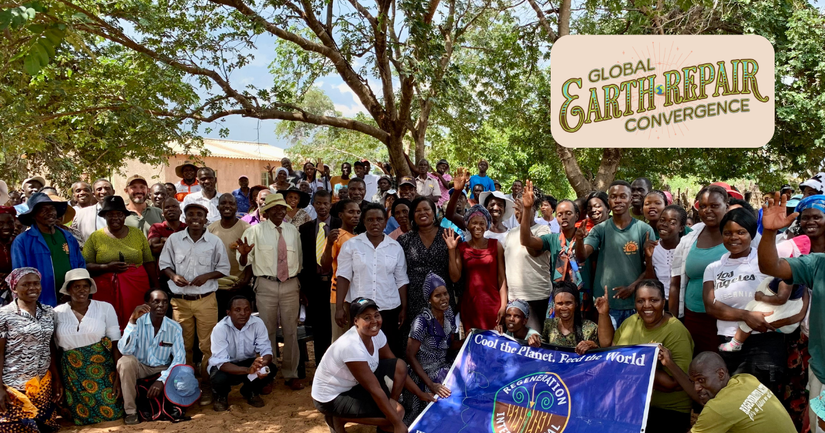
Africa at the Global Earth Repair Convergence
by Precious Phiri, Regeneration International Africa Coordinator
The African Segment of the Global Earth Repair Convergence, running 8–10 May 2026 online via Zoom, under the theme Repairing Landscapes, Agriculture, Livelihoods & Systems. It sits within the broader global event (7–11 May), which draws 500+ in-person participants in Washington State and thousands more online worldwide.
The three-day programme:
Day 1 – Repairing Landscapes: Ground-level practitioner voices on what’s actually working in African soils, watersheds, and ecosystems.
Day 2 – Repairing Food Systems & Communities: Agroecology, seeds, local markets, and community-led food systems restoring both land and livelihoods.
Day 3 – Repairing Systems: Finance, technology, funding frameworks, and the infrastructure needed to scale restoration across the continent.
Each day has two sessions — a morning slot (9:00–11:30 CAT) focused on keynotes and practitioner knowledge, and an evening slot (17:00–18:55 CAT) for panels, breakouts, and collective discussion.
Learn More

Beacons of Hope: Stories from the Land-Water Nexus
by Global Alliance for the Future of Food
"In Australia’s Northern Territory, after decades of exclusion from customary rights, Aboriginal fishers are rebuilding coastal economies with commercial licences, mentoring, cultural authority, and a pathway to city buyers. On Canada’s west coast, Indigenous-led action to dismantle destructive commercial fish farms is helping to restore revered wild salmon stocks and support the return of orcas. In Uganda, fisherwomen are at the forefront of resisting military violence, state-imposed hunger, and abuse from foreign investors as they organize to reclaim the right to fish and farm. And in South Africa, decades of anti-apartheid struggle have set the stage for traditional fishing communities to mobilize and advocate for legal recognition of fishers’ rights.
These stories from around the world reveal the powerful connections between fisher movements fighting for food sovereignty and livelihoods, resisting oil and gas exploration and extraction, exposing the impact of pesticides and agrochemicals on land and water, and protecting cultural fishing rights as essential to biodiversity."
Learn More
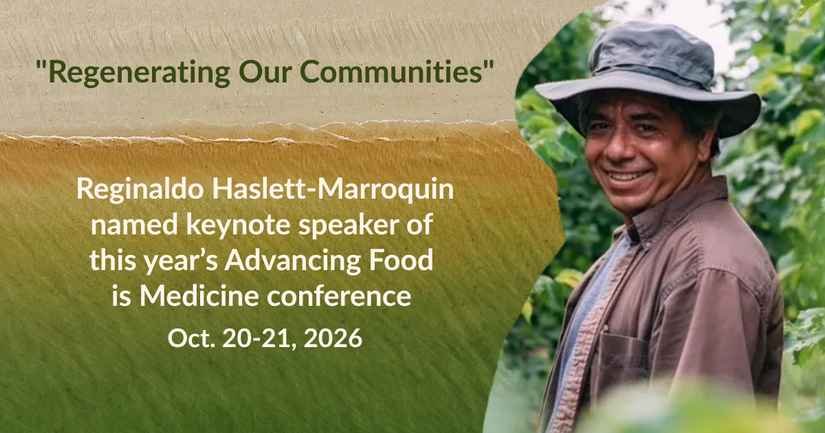
Reginaldo Haslett-Marroquin Named Keynote Speaker at the 2026 Advancing Food is Medicine Conference
by Think Regeneration
"EDMOND, Oklahoma—Think Regeneration is honored to announce that Reginaldo Haslett-Marroquin will be giving the opening keynote talk at the 2026 Advancing Food is Medicine conference Oct. 20-21, 2026, in Edmond, Oklahoma. The conference’s theme this year, “Regenerating Our Communities,” fits the work that Regi has been organizing for decades.
In 1988, Regi began working on economic development projects with indigenous Guatemalan communities, serving as a consultant for the United Nations Development Program’s Bureau for Latin America and as an advisor to the World Council of Indigenous Peoples and was a founding member of the Fair Trade Federation in 1994. Since migrating to the US in 1992, Regi has led the creation and launch of multiple enterprises.
His first significant contribution to the United States’s social enterprise sector was in 1995 when he founded Peace Coffee, a Minnesota-based fair-trade coffee company. Regi’s social enterprise development work includes woodland owner cooperatives and a multitude of inner-city new immigrant enterprise efforts in Minnesota."
Learn More
How Homeopathy Can Prevent and Reduce Livestock Disease
by Emma Gillbard
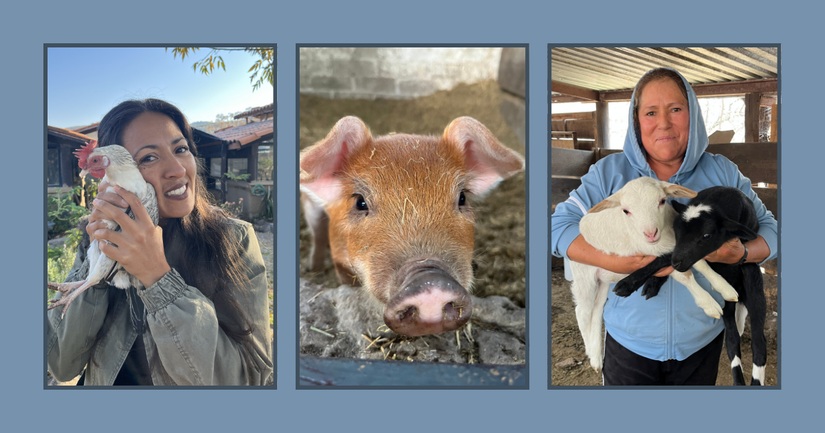
"Integrating homeopathic and preventative protocols into livestock systems can avoid up to 80% of common health problems, according to veterinary surgeon and homeopathic vet Chris Aukland.
“Disease doesn’t just happen,” he says. “It is a process that builds up overtime, and when tipped over the threshold goes into crisis, where disease symptoms show.”
Stress is often the pre-cursor of disease, making animals prone to infection, he adds.
Every farm has unavoidable stress events such as livestock transportation, mixing of groups, new situations, birth, weaning, weather or nutritional change."
Learn More
|
|

This Tiny Wildflower Could Be a Secret Weapon Against Superbugs
Long before we had modern antibiotics to rely on, people often turned to traditional medicines from plants to treat infections. The root of tormentil (Potentilla erecta), a small yellow wildflower that grows across Ireland, the UK and Europe, was used for centuries in Irish and European traditional medicine.
Increasing the Share of Organic Farming Leads to Healthier, More Diverse Soils, International Study Finds
An international team led by University of Alicante (UA) scientists has found that increasing the share of organic farming may improve crop yields and help maintain soil health and biodiversity.
Start Small, Grow What You Like and Be Realistic: How to Start a Vegetable Garden
You don't need a yard or balcony to get going. We asked experts for their advice on how to grow your food.
Rethinking the Farm Bill: Tell Us Where Our Beef Comes From
We sat down with California rancher Carrie Richards to discuss how restoring Mandatory Country of Origin Labeling (MCOOL) for beef is critical for independent ranchers like her. The policy requires meat labels to state where an animal was born, raised, and harvested—but since Congress repealed it for beef and pork in 2015, that information is no longer required.
AFSA Newsletter – A Bold Chronicle of Agroecology in Action
In these pages, readers will see how AFSA continued to link grassroots realities with continental and global advocacy. This edition highlights the adoption of the Lilongwe Declaration on agroecology based school and college meals, AFSA’s participation in ICARRD+20 in Colombia, the launch of a major report on the African Development Bank’s role in reshaping African agriculture, renewed calls to centre farmers in regional seed policy processes, and important internal moments of alignment through the AFSA staff retreat, the Citizens Working Group on Agroecology meeting, and the TAFS annual review workshop.
AB 1731: Building a Stronger Connection Between Farms and Schools
Assembly Bill 1731—the California Healthy Food Procurement Fund Program— brings us closer to making that vision a reality. We’re proud to support this effort to better connect California farmers with local schools and expand access to fresh, nourishing food for students across the state.
Regenerative Grazing Study Reveals Trade-Offs for Sheep Farmers
A new Tasmanian Institute of Agriculture (TIA) study has found that while regenerative agriculture practices can improve soil health and reduce emissions on sheep farms, farmers often face trade-offs between environmental and economic goals. The article, “Regenerative agriculture improves productivity and profitability while reducing greenhouse gas emissions on Australian sheep farms,” has been published in Nature Food.
Medicinal Plants for a Healthy Gut Microbiome: Scientific Insights into Modern Herbal Applications
This article explores the therapeutic potential of several common botanicals in modulating the gut microbiota and promoting intestinal health. We delve into the phytochemical composition and pharmacological properties of nine medicinal plants: globe artichoke, aloe vera, German chamomile, pot marigold, Ceylon cinnamon, dandelion, fennel, garlic, ginger, and green tea.
The Upcoming EU Seed Law and Its Implication for Agrobiodiversity
Imagine being told you are no longer allowed to grow potatoes, lentils, beans, or even wheat in your backyard. It sounds absurd — yet this is precisely the kind of restriction that could become European law if ongoing negotiations on seed regulation go the wrong way.
Study: Amazonian Wildlife Feeds Millions
New research reveals how humanity’s health is tethered to that of its ecosystems.
Advancing Markets for Producers (AMP) Program
This project will implement regenerative production practices including no- and reduced-till, nutrient management, and soil carbon amendment activities, on a large-scale across cropland planted to fruits and vegetables.
How to Reduce Your Exposure to Pesticides
Scientists still don't fully understand the health risks of the chemicals. Here's how they recommend protecting yourself.
The Unexpected Role of Hair, Fur and Wool in Sustainable Agriculture
The quiet fiber cycle, a term coined by Matter of Trust, describes a process of recycling hair, fur and wool to regenerate the soil and promote ecosystem health. And, the idea has taken root with recycling companies, nonprofits, farmers and researchers alike.
One-Cow Revolution
For more than three decades, Shawn and Beth Dougherty have honed their frugal methods for managing a small-scale farmstead on marginal land. In One-Cow Revolution, they share their wisdom and affection for the blessing that is the human-dairy cow partnership, addressing key questions with clear answers for those who have just moved back to the land (or are still planning and dreaming).
|
Upcoming Events |

In Person:
04/28 - Congreso de Agricultura y Ganadería Regenerativa. Sonora, México.
04/28 - IFOAM Animal Husbandry Alliance Conference 2026. Frick, Switzerland
04/29 - Regenerative NYC'26. New York City, USA.
04/29 - Regenerative Agriculture Europe Summit. London, UK.
05/07 - Africa at the Global Earth Repair Convergence. Washington, USA.
05/12 - LARIS 2026. Bogota, Colombia.
Online:
04/28 - Hybrid - IFOAM Animal Husbandry Alliance Conference 2026
04/30 - Webinar – Regenerative Minimum Standards: Work Group on Synthetic Inputs
05/07 - Hybrid - Global Earth Repair Convergence.
05/07 - Webinar – International Conference on Homeopathy in Agriculture and Environment 2026.
*Click here to view full events calendar and submit your own
|
|
|


Regeneration International is an independent 501(c)(3) nonprofit, dedicated to building a global network of farmers, scientists, businesses, activists, educators, journalists, policymakers and consumers who will promote and put into practice regenerative agriculture and land-use practices that: provide abundant, nutritious food; revitalize local economies; regenerate soil fertility and water-retention capacity; nurture biodiversity; and restore climate stability by reducing agricultural greenhouse gas emissions while at the same time drawing down excess atmospheric carbon and sequestering it in the soil.
This email was sent to
Click Here to Unsubscribe