|
|


|
|
Jump to: Featured Articles | Events Calendar | Translate Newsletter Online

2025: 10 Years of Regeneration and Beyond
by Ercilia Sahores, RI Co-International Director
This year, Regeneration International celebrated a decade of collective action, with ten years of grassroots organizing, global solidarity, and soil-deep transformation. Our partner network has now grown to more than 700 organizations.
We also marked a major milestone with our 5th Annual People’s Food Summit, a global online gathering of farmers, activists, scientists, and community leaders reimagining the future of food. This year’s summit reached an extraordinary 10 million people worldwide, amplifying the voices and solutions that are reshaping our food systems from the ground up.
In 2025, our movement reached deeper into landscapes and communities across the Global South.
We advanced landscape-level regenerative initiatives in Africa and Latin America; supported healthy soils and healthy food campaigns; expanded global trainings on the Billion Agave Project; strengthened community-led seed and food sovereignty efforts; and continued defending native corn and promoting truly healthy tortillas across Mexico. This year, our team was invited to speak on high-level panels around the world, ensuring regeneration remains central to the global policy conversation.
Learn More

PELUM Network @30: Celebrating Three Decades of Regional Agroecology & Farmer-Led Leadership
by Precious Phiri, Africa Coordinator, Regeneration International & Southern Africa Focal Point, CSIPM Coordination Committee
This year marks a significant milestone for the agroecology movement across Southern and Eastern Africa: the PELUM Network celebrates 30 years of transformative, people-led work. Founded first in Zimbabwe in October 1995, PELUM (Participatory Ecological Land Use Management) emerged as a regional association connecting smallholder farmer organisations committed to agroecology, indigenous knowledge, and ecological restoration.
At Regeneration International, we have enjoyed PELUM networks contributions to our platforms such as The Peoples’ Food Summit. I had the honor of attending the PELUM 30th Anniversary celebrations during the PELUM AGM, 2025 convening, a moment that reaffirmed the strength of this movement and the solidarity that has carried it for three decades.
Congratulations, and Onward PELUM Network!
Thirty years on, PELUM’s model, community-led practice supported by strong country chapters, remains essential to the future of African food systems. From the doorstep to the landscape, PELUM continues to show how interconnected, organised action can transform our relationship with land, seed, and food while providing a platform for policy influence.
Here’s to the next three decades of agroecology, solidarity, and farmer-led change.
Learn More

The Regeneration International Academy in Partnership with the South Seas University, announces the Certificate Course on Agroecological, Regenerative and Organic Agriculture (AROA)
We are excited to announce that another Certificate Course on Agroecological, Regenerative, and Organic Agriculture is starting soon.
Discover how to grow food in ways that restore ecosystems, build healthier soil, and support long-term resilience.
Regeneration International’s certificate course, offered in conjunction with South Seas University and taught by André Leu, blends regenerative agriculture, organic farming, and agroecology into a practical, science-based program that empowers you to design productive, climate-resilient farming systems.
Whether you’re a grower, student, or sustainability advocate, this course provides the tools, global perspective, and credibility to make real impact. Join a worldwide network of practitioners and learn how to shift agriculture from extractive to regenerative, creating healthier farms, communities, and landscapes.
You’ll leave the course with practical strategies you can apply immediately, whether you’re improving an existing farm, launching a new project, or contributing to policy and community initiatives. Grounded in essential regenerative principles, the program strengthens your confidence and skills to advance meaningful change in food and farming systems. More than a training, this certificate connects you to a global movement and equips you with the science-based tools and knowledge you’ve been seeking.
A reduced price is available for anyone with limited income who wants to participate. Please join us!
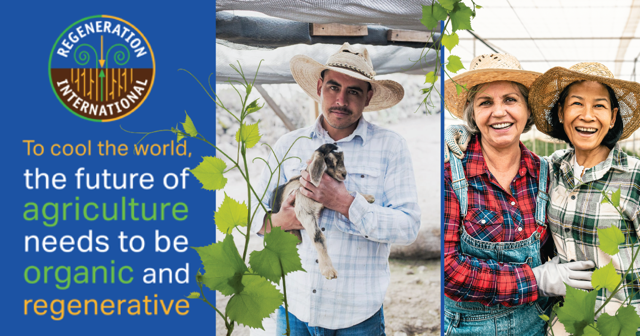
Support Our Work
Join us in commemorating a decade of groundbreaking work in regenerative agriculture, sparked by the visionary gathering of farmers, scientists, organizers, and activists.
Over the past decade, Regeneration International has grown from these early efforts into a global movement, launching initiatives that are transforming the way we approach food, farming, and the future of our planet.
Some highlights include the People’s Food Summit: Amplifying grassroots voices and promoting food sovereignty - The Billion Agave Project: Reforesting arid lands and promoting sustainable agriculture - Regenerative education programs worldwide: Empowering communities to adopt regenerative practices.
And we are excited to announce The Regeneration International Standard: Ensuring the integrity of the “regenerative” label and promoting accountability.
Please help us keep the moment going. Your contribution will help us continue to promote regenerative agriculture practices globally, support grassroots movements and community-led initiatives, implement standards for regenerative agriculture, as well as educate and empower consumers to make informed choices.
Donate today and help us build on Regeneration International’s momentum over past decade to give more people an opportunity for a healthy organic and regenerative life and future.
Make a tax-deductible donation to Regeneration International
Support our Work ♡ Donate Today

The Science Shows Glyphosate Must Be Banned
by Dr. André Leu D.Sc., BA Com., Grad Dip Ed. International Director, Regeneration International
New research has dismantled claims that glyphosate is safe. A key industry-backed safety review has been retracted for academic misconduct, and a landmark 2025 lifetime study found increased cancer rates at doses far below current regulatory “safe” limits.
These findings reinforce existing human epidemiological evidence linking glyphosate exposure to cancer and chronic disease, undermining the scientific basis regulators have relied on for decades. The weight of evidence now points to a clear failure to adequately protect public health and the environment.
The growing scientific consensus is clear: glyphosate-based herbicides must be banned to safeguard human health, ecosystems, and future generations.
Read More

Bringing Agroecology and Regenerative Agriculture to Global Policy
by Precious Phiri, Africa Coordinator, Regeneration International & Southern Africa Focal Point, CSIPM Coordination Committee
I had the privilege of representing Southern African civil society and Regeneration International (RI) at the 53rd Session of the UN Committee on World Food Security (CFS) in Rome. It was also my first time contributing directly to global policy discussions as part of the Coordination Committee of the Civil Society and Indigenous Peoples’ Mechanism (CSIPM), where I serve as Focal Point for Southern Africa.
Being in that space reminded me just how important it is for grassroots voices, especially farmers (fisher, crops), pastoralists, and women, to be heard in global decision-making. We often speak about food systems in big terms, but for me, the heart of it is simple: people and land. Experiencing how CSIPM brings perspectives from communities practicing Agroecology and regenerative agriculture felt like a breath of real life into the room.
RI’s Presence in the Policy Space
The CFS is one of the few global platforms where civil society and social movements have a recognized seat in policy discussions. That in itself is powerful, it means our movements can help shape the direction of food and agriculture policy, not just respond to it.
At this year’s session, RI’s voice contributed to conversations on resilient food systems, land rights, gender, and seeds. I was especially grateful to speak at the SWISSAID and IFAD side event on Neglected and Underutilized Species (NUS), sharing how local seed custodians in Africa are wading the challenging waters of farming systems.
More Information
More About the CSIPM Intervention – Office of the High Commissioner for Human Rights (OHCHR)

Agave As Fodder for the Future of the World's Arid Zones
by Eng. Alejandro Vasconcelos Peña, Director of the Implementation of the Billion Agave Project and Founder of 4 Agaves
Water scarcity and declining groundwater quality are driving a global fodder crisis, deepening inequalities for farmers and pastoralists—especially in arid regions. Addressing this challenge requires resilient, regenerative solutions that work with nature rather than against it.
The Billion Agave Project (BAP), an initiative of Regeneration International, promotes agave as a pioneer species uniquely suited to dry landscapes. With exceptional water efficiency and multiple high-value uses, agave supports local job creation while helping restore degraded lands, enhance biodiversity, and build regenerative agroforestry systems that integrate agaves, grasses, and trees.
Compared to conventional fodders like corn silage, alfalfa, oats, and sorghum, agave requires far less water and lower production costs, making it a viable fodder base for water-stressed regions worldwide.
Learn More

From Degeneration to Regeneration: Understanding the RI Standard
As “regenerative” becomes a marketing buzzword, the RI Standard provides a clear, accessible benchmark that protects the integrity of regenerative agriculture. It is designed for farmers worldwide, including those in developing regions, to move from industrial, degenerative systems toward true ecological and social regeneration. Designed to work alongside organic standards or on its own, the RI Standard is being translated into multiple languages and rolled out across more than 80 countries. RI also offers a university-accredited online certificate course in regenerative and organic agriculture.
Why a New Standard?
Many existing standards allow synthetic chemicals and GMOs while still calling themselves “regenerative.” California’s recent definition, which permits these inputs, highlighted the need for a rigorous, farmer-friendly alternative grounded in organic principles.
Two Certification Pathways, Transition Planning, Continuous Improvement
The RI Standard offers two levels: Regenerative A-Grade for full compliance, and Regenerative in Transition for farms actively working toward it. This structure supports real-world progress without demanding perfection overnight. Producers must maintain an annually updated transition plan outlining how they will phase out prohibited practices and improve soil health, biodiversity, water systems, and community wellbeing.
Principles and Prohibitions
Instead of rigid checklists, the Standard emphasizes principles, guidance, and continuous improvement. It includes mandatory prohibitions on synthetic pesticides, water-soluble chemical fertilizers (with narrow exceptions), synthetic feed and food additives, sewage sludge, and GMOs - including gene editing.
A Needed Evolution
By filling critical gaps in existing standards and supporting farmers through practical transition pathways, the RI Standard helps drive a global shift toward agriculture that regenerates soils, ecosystems, and communities.
Learn more about the Regeneration International Standard and Get Certified
|
|

One of the Last Ancient Temperate Rainforests on Earth Is Being Clearcut in the Headwaters of the Walbran Valley, BC Now
This will be a short post, I threw the above video together in a hurry as the psychotic RCMP, government profiteers, logging corporations and their fellers are currently destroying extremely endangered primary forest habitat as you read this.
The Indigenous Women Changing the Course of Their Communities
Indigenous women leaders don’t only sustain life in their territories; they are also active defenders of water, seeds, ancestral knowledge and biodiversity. Together, they lead environmental restoration processes and care for the health of their communities. They also pave the way for political participation, claiming spaces where decision-making affects their communities.
Elderberry Is a Sacred Indigenous Plant. Should It Be Monetized?
As demand increases in the US, some producers are exploring whether and how to commercialize a Native staple.
Africa’s Silent Crisis: Soil Erosion and How Farmers Fight Back
In 2022, Kagarko, a ginger farmer from Aribi in Kaduna, Nigeria, watched his harvest collapse from the usual 100 bags to just 10. A year later, Boniface, a yam farmer from Kogi State, suffered the same fate when her tubers were fewer, smaller, and barely worth storing.
Regenerating Soil, Securing Tomorrow
In a world facing climate crises, production pressures, and increasingly exhausted soils, soil health is emerging as one of the most urgent priorities of our time. Beneath our feet lies much of the future. Agricultural productivity, food security, rural economies, and the adaptive capacity of millions of families depend on a living resource that is seriously threatened, yet still capable of regeneration through science, collaboration, and decisive investment in evidence-based solutions.
World Soil Day 2025: Improving Soil Health Through Regenerative Agriculture
Soil health is the cornerstone of regenerative agricultural transition. Healthy soils store water, cycle nutrients, and buffer against droughts and floods, helping farms adapt to climate change and be more resilient.
GMOs Will in the Longrun Completely Destroy Africa’s Agriculture and Millions of Lives
While in Malawi and Zambia, last year, farmers in various communities, that I visited, also cursed Monsanto and other biotech companies that are behind the production of GMOs seeds/plants. My constant interaction with grass root farmers from various African countries, raises so many pertinent issues, which African governments and policy makers’ needs to come open about and let the public know the truth behind GMOs.
EPA, MAHA Commission Urged to Assess Christmas Tree Pesticides Risks to Children
The Center for Biological Diversity and Alliance of Nurses for Healthy Environments petitioned the Environmental Protection Agency and President’s Make America Healthy Again Commission today to address the health risks posed by the heavy use of toxic pesticides on Christmas trees. Tree farms in Oregon, Michigan, Pennsylvania, California, Florida and Texas that produce nearly two-thirds of the Christmas trees harvested in the U.S. have reported spraying 270,000 pounds of pesticides each year. Many of these pesticides include products known to be potent endocrine disruptors, carcinogens and neurotoxins that impede children’s brain development. The pesticides are chlorothalonil, simazine, glyphosate, hexazinone, carbaryl, chlorpyrifos and dimethoate.
The US E.P.A. Can No Longer Hide Behind Ghost Written Bogus Study on Glyphosate
Williams et al. (2000) has (finally) been retracted, per the journal, "to preserve the scientific integrity of the journal."
|
Upcoming Events |

In Person:
01/08 - Minnesota Organic Conference
01/14 - Health Begins in The Soil
01/21 - 46th Annual EcoFarm Conference
Online:
12/17 - Webinar: Advancing Regional Organic Markets: A Farmer’s Toolkit (Plains)
12/18 - Webinar – Improving Your Crop Rotation
01/14 - Webinar - Transition to Organic Webinar Series
*Click here to view full events calendar and submit your own
|
|
|


Regeneration International is an independent 501(c)(3) nonprofit, dedicated to building a global network of farmers, scientists, businesses, activists, educators, journalists, policymakers and consumers who will promote and put into practice regenerative agriculture and land-use practices that: provide abundant, nutritious food; revitalize local economies; regenerate soil fertility and water-retention capacity; nurture biodiversity; and restore climate stability by reducing agricultural greenhouse gas emissions while at the same time drawing down excess atmospheric carbon and sequestering it in the soil.
This email was sent to
Click Here to Unsubscribe